
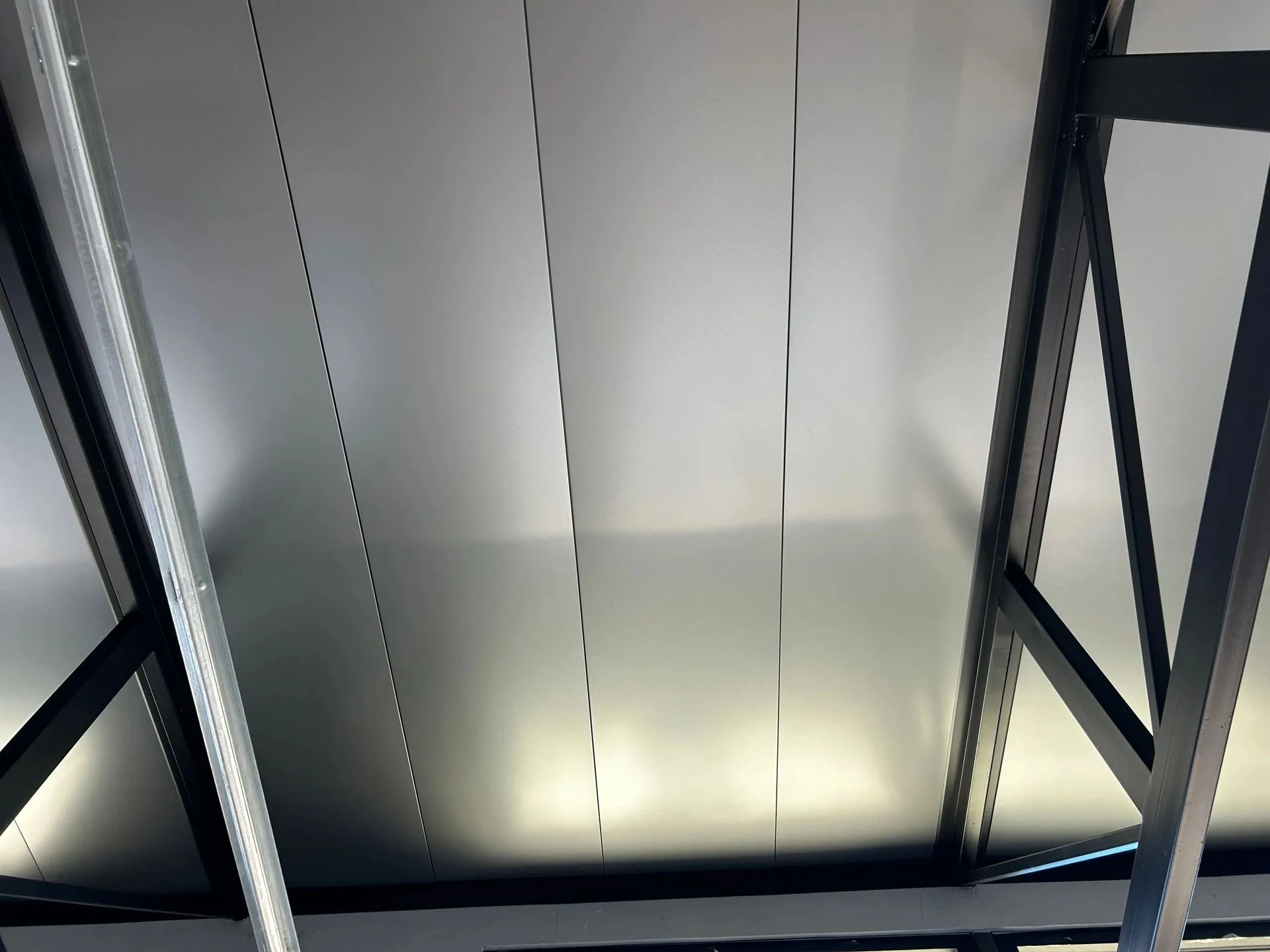
Sealing soffit covers, and the under-deck systems that keep them dry.
A soffit is the part of the roof you stare up at when you’re standing on the porch: the underside of the eave, the ceiling of the entry, the bottom of the second-story deck cantilever. In Arizona, the soffit takes the brunt of reflected UV off concrete and stucco, fights monsoon-driven moisture under the eave, and lives with the bird and insect pressure that comes with year-round 70°F-plus temps. Wood soffits crack and check in that environment. Vinyl soffits sag and yellow. Metal soffit covers don’t. We fabricate sealing soffit panels on the same roller-set we use for walls, in widths and lengths that drop in clean over your existing soffit framing, and we fabricate the under-decking systems that make second-story decks dry-below.
What we fabricate.
- Sealed soffit panels. Flush or lightly-ribbed, full-coverage, no perforations. The finish read of choice for porches and entry ceilings where you want a clean monolithic look and don’t need attic venting through the soffit.
- Vented soffit panels. Same panel face with discrete venting strips on a regular pitch, for attics that breathe through the eave. We size the open vent area to your soffit run.
- Under-decking systems. For second-story decks where the deck above is the porch ceiling below. A sloped metal under-deck collects any water that gets through the deck boards above and channels it out to a gutter, leaving the lower porch dry through monsoons. We fabricate the under-deck pans, the closure flashings, and the gutter to match.
- Eave / fascia transition flashings. The small custom pieces that tie the soffit into the fascia and the wall, brake-formed in our shop to your fascia depth.
Specs.
- Gauge: 24 ga Galvalume steel. .032 aluminum option for projects where galvanic compatibility with aluminum-trim assemblies matters
- Coatings: Kynar 500® PVDF (best for the UV exposure a south-facing soffit gets in Tucson summer), SMP for a value option, and wood-grain printed metal for porch ceilings: a real-wood look on a metal substrate, popular on covered patios and outdoor kitchens where a stained-wood ceiling would otherwise weather hard
- Profiles: flush, lightly-ribbed, or beadboard-style for the pueblo / craftsman aesthetic
- Vent options: continuous vent strip, perforated panels, or solid. We size the open area to your soffit ventilation requirement
Why metal.
- No warping or rot. Wood soffits in AZ check, split, and start dropping pieces by year five. Metal stays flat.
- No insect damage. Termites, carpenter bees, and wasps that ruin wood soffits leave a metal soffit alone.
- Paint film holds. Kynar 500 PVDF is rated for a 30-year fade warranty in the high-UV applications metal-soffit panels see. SMP is shorter.
- Cleans with a hose. Porch ceilings collect dust and bug residue. Metal washes off, wood doesn’t.
- Reads finished. A printed wood-grain metal soffit reads as stained tongue-and-groove from any reasonable distance, but lasts decades longer.
Pairs with.
- Snap-Lock Standing Seam Panels. The soffit usually pairs with the same coating family as the roof.
- Metal Fascia Covers. Wrap the fascia in matching metal so the whole eave reads as one cohesive finish.
- Materials, Colors & Wood-Grain Finishes. The full coating and color palette.
Warranty.
- 35-year metal warranty on the panels (substrate and finish. Wood-grain print carries a 30-year fade warranty on the printed pattern)
- 45-year installation warranty when installed by a US-Metal-Roof-certified installer. DIY and 3rd-party-installer installs are covered by the 35-year metal warranty only.